

Community Has Impact. It Doesn’t Carry Across GTM.
Why community-led growth falls short and how community-integrated GTM changes decision-making and outcomes across teams.

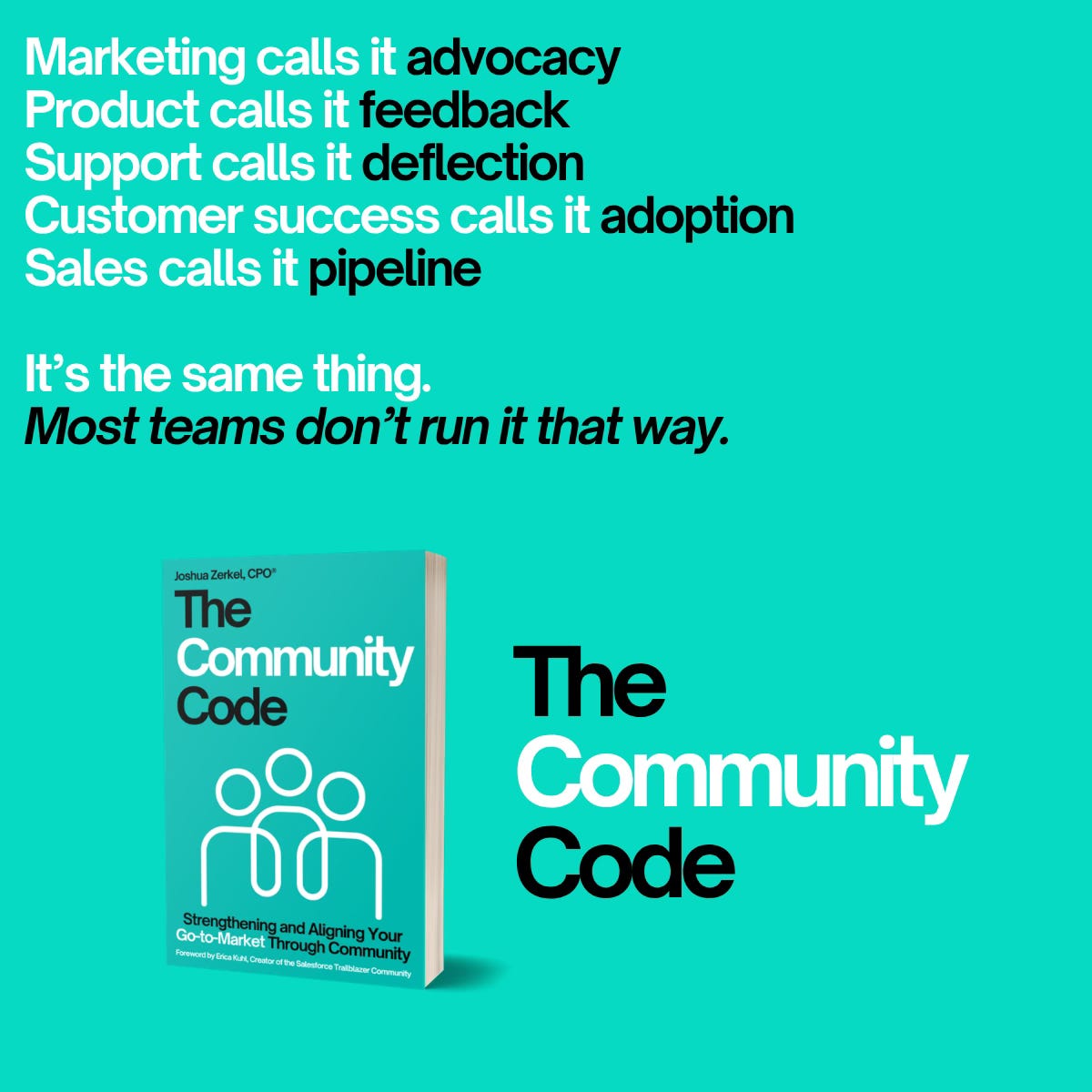
Today, my new book, The Community Code, is officially out.
This book comes out of a pattern I kept running into across companies, roles, and stages. Community was clearly doing something valuable. Customers were helping each other learn the product, sharing use cases, influencing adoption, and in some cases shaping pipeline and expansion.
But that impact rarely translated across the rest of the organization.
Individually, the signals were easy to point to. Collectively, they were harder to make sense of. That’s where things tend to break down.
Why this book exists
Inside the company, each team interprets what it sees through its own lens. Marketing frames it as advocacy. Product treats it as feedback. Customer success sees adoption patterns. Sales looks for proof points to support deals in motion.
All of those interpretations are valid. The problem is that they don’t connect in a way the business can actually operate on.
What looks like a cohesive system from the outside gets broken into pieces on the inside. As a result, community ends up feeling simultaneously important and hard to justify. There’s visible impact, but no shared understanding of how that impact moves through the business.
This book makes that system visible and usable.
Where community-led growth falls short
“Community-led growth” helped move the conversation forward. It gave the work more weight and tied it to outcomes leadership already cared about.
That shift mattered. But in practice, it also introduced a mismatch.
Most organizations aren’t designed for any single function to lead growth on its own. Product, marketing, sales, and customer success each control different parts of the lifecycle, and growth shows up when those parts reinforce each other over time.
Community doesn’t sit neatly inside that structure. It cuts across it. So expectations expand, but decision rights and operating models don’t change alongside them.
As companies scale, the result becomes obvious. Multiple versions of “community” start to appear across the org. Marketing builds advocacy programs. Customer success builds onboarding and support spaces. Product runs betas or feedback groups. Developer relations builds ecosystems.
Each effort makes sense in isolation. Each is tied to a clear goal. But they’re owned by different teams, measured differently, and rarely connected in a way that reflects how customers actually experience the product.
From the company’s perspective, the structure is rational. From the customer’s perspective, it’s fragmented.
The problem isn’t belief, it’s translation
At this point, most GTM leaders don’t need to be convinced that community has value. The harder problem is making that value usable.
Signal is generated in one place and consumed in another. Context gets lost along the way. Teams fall back on their own proxies because the underlying system isn’t visible enough to work from directly.
That’s why the same patterns keep repeating. Product teams see spikes in requests without full context. Marketing highlights stories that resonate externally but don’t fully reflect usage. Sales leans on isolated proof points. Customer success sees early signs of friction but struggles to connect them back to upstream decisions.
These aren’t failures of execution. They’re artifacts of how the system is structured.
Without a shared way of carrying signal across functions, each team optimizes locally. The result is a set of decisions that make sense individually but don’t consistently reinforce each other.
From fragmented signal to community-integrated GTM
A more durable approach starts by changing how community shows up in the system.
Not as a standalone program, and not as a function that owns outcomes, but as a way of feeding shared customer signal into how product, marketing, sales, and customer success actually operate.
When that signal is visible and consistently used, things change in a way that’s hard to fake. Product decisions reflect how customers are using the product in context, not just isolated requests. Marketing messaging aligns more closely with how customers describe value in their own words. Sales conversations carry examples that generalize. Customer success leans more on peer momentum instead of purely reactive support.
What changes isn’t any single output. It’s how those outputs start to reinforce each other.
That reinforcement is where leverage shows up. It’s also where most community efforts stall, not because the work isn’t valuable, but because the system around it isn’t designed to absorb and use that value consistently.
How this looks in practice
You can see this in companies that have invested in connecting customer signal across functions.
At Asana, the community forum, ambassador program, and events surfaced patterns around how teams were adopting the product, where they were getting stuck, and how use cases were evolving over time. That signal showed up in product conversations, influenced how customer stories were told, and informed how teams approached onboarding and expansion.
At Atlassian, community conversations often surface emerging needs and workarounds long before they appear in formal feedback channels. That signal feeds into product teams, partner ecosystems, and support content, creating a more connected view of how customers are actually using the platform.
In both cases, the value of community isn’t just in the interactions themselves. It’s in how those interactions inform decisions across the rest of the organization.
That doesn’t happen automatically. It requires intentional design around how signal is captured, translated, and shared.
What the book does
The Community Code breaks this down directly.
It maps how customer signal actually moves across go-to-market, where it gets lost, and how to integrate it into the way teams operate day to day.
This isn’t about elevating community as an idea. It’s about changing how work happens across product, marketing, sales, and customer success so they operate from the same underlying inputs.
If you want to go deeper, you can learn more about The Community Code here.
Decoded Takeaways
Community generates some of the earliest and most nuanced customer signal, but that signal often fragments as it moves across teams
“Community-led growth” elevates the importance of the work, but doesn’t resolve how it fits into vertically structured organizations
The core issue isn’t belief in community’s value, it’s the lack of a shared system to translate that value into decisions
A community-integrated approach creates a common layer of signal that product, marketing, sales, and customer success can operate from
Durable advantage shows up when those functions start reinforcing each other based on the same underlying inputs
Related Posts
Why I No Longer Say “Community-Led Growth”
Where the language starts to fall apart in practice, and how it creates expectations most organizations can’t actually support.Where Community Breaks Down Inside GTM
How community gets fragmented across marketing, product, sales, and customer success, and what that fragmentation costs the business.What K-Pop Can Teach Go-to-Market Teams
A different lens on the same idea, showing how coordinated community behavior can shape distribution, adoption, and narrative without owning growth directly.
Congrats on the launch, Joshua!